History of Guelph, Ontario
From Vision to the Vibrant City We Love
If you stand at the meeting point of the Speed and Eramosa rivers and look up toward the limestone towers that pierce the skyline, you can see most of Guelph’s story in one view. Water, stone, faith, ambition—it’s a city that began as a bold plan on paper, grew through industry and agriculture, and learned how to reinvent itself while holding on to its roots.
Founding a Planned Town
Before survey stakes were hammered into the ground, this land lay within a Crown reserve connected to the Haudenosaunee of the Six Nations. By the 1820s, the Canada Company was eager to develop Upper Canada, and they hired a Scottish novelist-turned-promoter, John Galt, to open the interior for settlement.
On April 23, 1827—St. George’s Day—Galt marked the founding of the town by felling a maple tree at the rivers’ confluence. He laid out an unusual radial plan, with streets fanning from a central market square. This “wheel-like” design gave the new town both practicality and a theatrical flourish to impress settlers.
Galt named the community Guelph to honour the British royal family of the time, descended from the House of Welf (or Guelph). That connection earned it the nickname “The Royal City,” a title still proudly used today.
Building With Stone
Guelph’s defining feature is its stone. Limestone sits close to the surface here, and settlers wasted no time quarrying and building with it. From civic halls to mills to churches, the early cityscape rose in pale, rugged blocks that gave Guelph a sense of permanence.
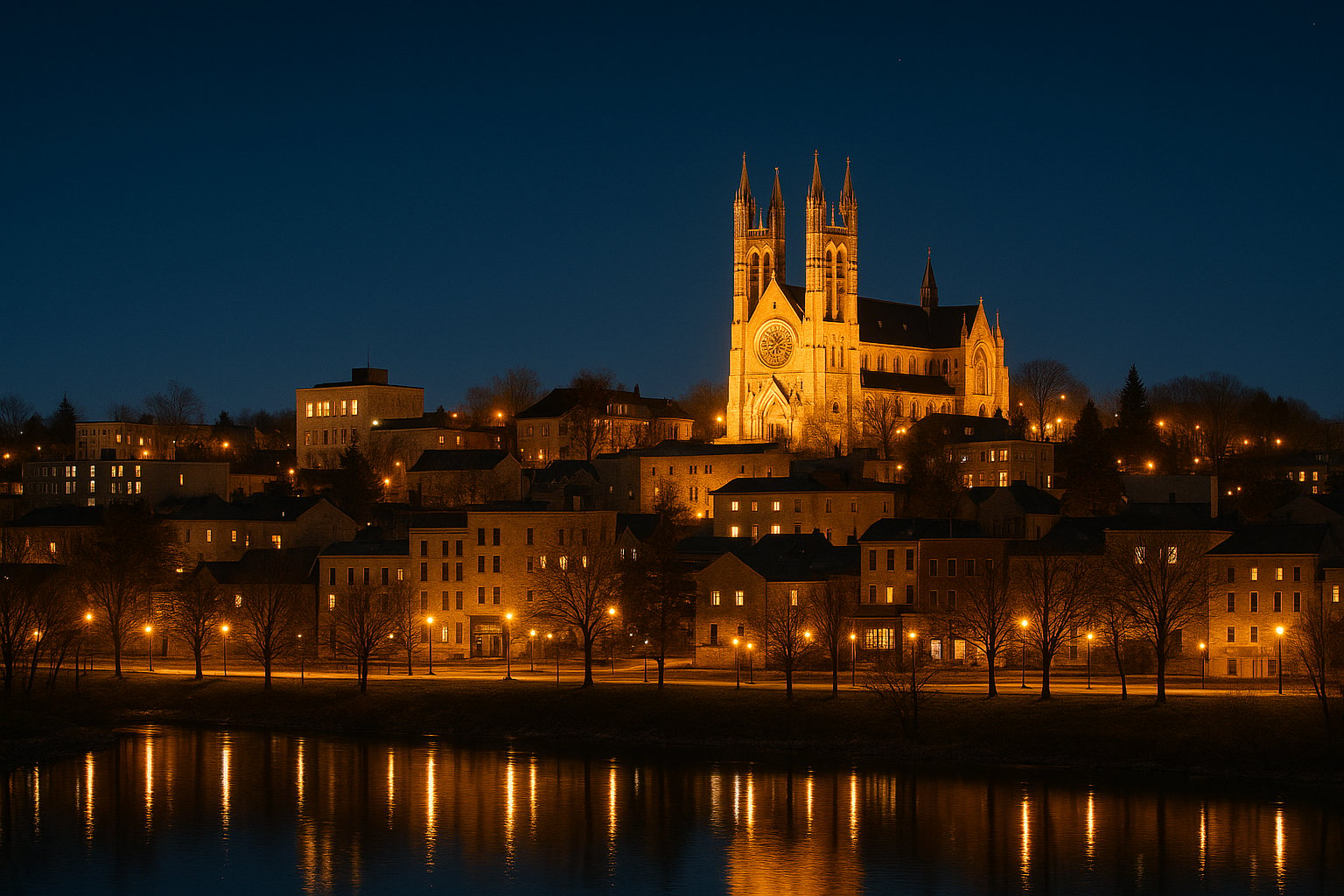
The crown jewel is the Basilica of Our Lady Immaculate, a Gothic Revival landmark designed by Joseph Connolly and built between 1876 and 1888. With its twin towers completed in the 1920s, it still dominates downtown. Step inside, and the stained-glass windows cast their colours on stone that has witnessed generations of ceremonies and quiet reflection.
Rivers and Daily Life
The Speed River cuts through the city, while the Eramosa sweeps in from the east, joining it near what is now Royal City Park. In the 19th century, factories, mills, and tanneries clustered along these waterways, taking advantage of the power they provided.
Today, the rivers remain central to Guelph’s identity. Trails, bridges, and parks hug their edges, while summer brings locals to the Boathouse Tea Room for ice cream and canoe rentals—a tradition as enduring as the rivers themselves.
Industry and Brewing
Industry found fertile ground early. Mills, foundries, and manufacturing shops grew alongside the town, supported by new rail lines that connected Guelph to broader markets.
One industry in particular became legendary: brewing. John H. Sleeman began brewing here in the 1830s, and by mid-century, the Sleeman Brewery was firmly established. Though Prohibition and a scandal shut it down for decades, the brand was revived in the late 20th century. Today, Sleeman is one of the best-known beers across Canada—and forever tied to Guelph.
Education and Innovation
In 1874, Ontario founded the Ontario Agricultural College (OAC) just outside town, followed in 1903 by the Macdonald Institute for home economics. The Ontario Veterinary College, one of North America’s oldest, relocated here from Toronto in 1922. Together, they laid the groundwork for the University of Guelph, officially established in 1964.
The university transformed the city. Its research in food science, veterinary medicine, and environmental studies earned global recognition, while the student population brought cultural vibrancy and economic strength. Today, the campus is home to landmarks like Johnston Hall and the Arboretum, which remain symbols of learning and community.
Memory and Remembrance
History isn’t just preserved in buildings. Guelph is also home to the McCrae House, birthplace of Lieutenant Colonel John McCrae, the physician-soldier who penned In Flanders Fields during the First World War. The modest limestone cottage is now a museum and memorial, reminding visitors that global history often springs from small, local roots.
Twentieth-Century Change
Through the 20th century, Guelph grew steadily. Immigration waves reshaped the community. Downtown adapted through booms, recessions, and suburban expansion. Unlike some cities, however, Guelph’s historic core retained much of its character—thanks to its stone architecture and a civic preference for preservation over demolition.
By the postwar period, manufacturing thrived, but so did cultural life. The arts community took over old industrial buildings, music venues flourished, and a strong co-op spirit grew—echoed in institutions like the Guelph Farmers’ Market, which dates back to the city’s founding.
A Modern City With Deep Roots
The late 20th and early 21st centuries brought diversification. Food innovation, green technology, and software industries joined traditional manufacturing and agriculture. The University continued to act as an incubator for research and entrepreneurship, while Guelph’s reputation as an environmentally conscious, community-minded city solidified.
Festivals now pepper the calendar—the Hillside Festival for music, the Guelph Jazz Festival, and cultural events that reflect a globally connected population.
Yet amid the modern bustle, the city’s essence remains visible. Trails still trace the rivers. Stone churches and civic halls anchor neighbourhoods. Farmers sell local produce steps from the downtown core. And the Basilica towers above it all, just as it has for more than a century.
Ambition With Durability
From John Galt’s maple-tree ceremony to today’s thriving university town, Guelph has always balanced ambition with durability. The founders built in stone because they could. The city invested in knowledge because it mattered. Residents, whether brewing beer, designing trails, or hosting festivals, have always leaned toward substance over flash.
Walk from the river junction up to the Basilica at sunset, and you can see that balance still in play. The rivers reflect the light, the downtown hums with energy, and the Basilica holds the horizon a little longer. Nearly two centuries after its founding, Guelph continues to grow—but always in a way that honours the qualities that made it a “Royal City” in the first place.